Monday, 19 May 2014

Post Production

VFX are a series of added imagery to an animation and live-action film.
Using compositing software, such as Adobe Photoshop or After Effects,  you can create backgrounds and textures to give a realistic feel to the animation.
Other techniques in VFX include Digital effects and animation, where computer generated graphics and made and added to the film, and green-screening, in which the film or animation is recorded over a green/blue background, and then the blue/green screen is keyed in to replace with the background for the film, making it look like the characters or objects are in the scene.
An example of the Green screen effect
http://realmedia.typepad.com/real_media/2009/03/fire-and-ice-book-trailer.html
With the effects added, the CG animation can be fully rendered. The Rendering process will take a long time, as every detail in the scene will be effected by the lighting, texturing and other added features which take up the amount of memory saved in the file. Rendering may vary in 2D animation, depending on the amount of key-framing, and additional detail.
When the renders are finished, they can be taken for editing.

Editing the video and sound may be the easiest part of the pipeline, but a lot of effort and care must be put into it. The editor must ensure that the audio and visuals are synchronized correctly at the right pace, and include all the necessary sound effects in that scene. If any footage or scene makes the film slow down or make it irrelevant to the plot, then it will be removed from the final product. Added effects to the editing will include captions/subtitles and credits for the opening and closing of the film.

Friday, 14 March 2014

3D Production

In the production line for a 3D animation, the first step is create the layouts for the film. these are low-res geometrical models for the character/scene done by the layout artist, which is used to compose the shot and create a rough piece of animation following from the storyboards. Camera movements, depth of the field and composition of the models are looked at by the director, and then given the decision of whether they are approved.


Once approved, The layouts are to be taken to the modelling department. There, they are responsible for constructing the 3D models of the character, weapons, object, etc, whilst another department handles with backgrounds and surfaces, depending on how the department is split in between. Using the concept art as their source, they try to create a 2D design into a fully 3D character, while being assisted by a technical animator and enveloper to develop the skin and skeletons. This helps the modeler to then sculpt the facial expressions and any muscle shape required. After they are completed, the models are taken to be rigged and textured.

Texturing the model is done either by scratch, or by editing and image that exists. these are painting and shading techniques, which are written down directly from the artist, to be required for the scene and character. the textures are created into maps, which are divided up into several segments for the whereabouts on the model should have have a particular texture. this also applies to the character's clothing, skin or color, as shown in the example below.

http://cgi.tutsplus.com/articles/step-by-step-how-to-make-an-animated-movie--cg-3257

Lighting is also to be made during the production line. The artist needs to consider not just the types of lighting themselves, but also the elements and properties in the animation, camera moves, shades and textures it affects.these also reflect the color on the scene and any shadowy detail that appears in place.

Once everything is created, it needs to rigged. The character requires bones in order to move and bend, which can be done using the tools in the rigging process. this also involves a cloth simulation, which is developed to make the clothing move with the character in a way it looks in reality. the rigs are then tested and looked at, to see if any part of the character, any texture or anything in the rig should be adjusted before final approval.

Then, once it is approved. the animation itself can be created. during which, another department looks at what effects are needed in the animation, such as smoke, explosions or water, but do not work them until the final animation is completed and approved.

Friday, 10 January 2014

2D Production

Once Pre-Production line is complete and ready, we move on to the production line.

Here, I have split the production line to 2 different areas. This one is for the production of a 2D animation.

The main thing for 2D animation is making the keyframes and animating them. it takes a long time to create a frame each alone, and even longer if you have more than one character on each frame, making sure there are no mistakes, and that they move at the right pace. the keyframes would be followed from the storyboard and character designs that have been approved, therefore following the story and character for the film. When Animation was done traditionally on paper, the artists would draw each frame and test the character's movement by flicking back and forth the frames. With Flash and other similar computer software, you can use an onion-skin tool to see how each frame depicts the movement of the character, thereby helping you go back and edit any frame needed to adjust the right balance of the character and movement. if your animation includes character dialogue, then a dope sheet, along with recordings of the voices (depending whether it is necessary or not at the time), would be needed for the artist to draw the right mouth for each frame.

The animation itself would be put together by other departments, whom are in charge of adding colour, cleaning them up and taking camera shots of them in the order given (which is why each frame should be numbered). Approximately 2 seconds of animation would take a day to make. once every frame is made, coloured, cleaned up and given a shot, the animation will be taken to the final steps in the post-production line.

Friday, 13 December 2013

Pre-Production - Planning

There are many stages in the planning. after making the story and script. The first suggestion is a mood board. A Mood board is primarily a collage of images and texts, explaining what your idea is, what the story and how you want to present it, highlighting the styles you are looking at, the main points of the story, etc.

the main areas in planning are creating layouts and character designs. Layouts are mainly for the backgrounds and how the character should be made, i.e. their clothing, facial expressions, an so on. Its okay to create as many different designs you want on the character, as these ideas can be discussed until everyone is satisfied with it. these are also simple drafted drawings to give an idea of the setting for a story scene. showing the scene at a certain distance or angle can be an interesting look to appease the audience.

Other forms of character designs are made by a lot of drawings. so, some ideas should be tested out as concept art. these help give an idea on what style would look best on them, and whether or not the design looks on the character, or the character itself. once getting an idea of the character that is approved, you should create a model sheet of the final character to highlight the character shape and form. there should also be a series of other drawings expressing his movements and emotions, and any other possible outfit designs that could suit him/her. These final design sheets will help other artists and animators with the character creation and animation in the later production.

While characters and settings are worked on, the story can also be drafted in the form of a storyboard. Like a comic strip, but with captions at the bottom, you can simply explain the story in process, highlighting any proposed camera angles, how light or dark the scene could be, the position of the characters, being either close or far away, or if the camera is just on the one character. the storyboard should tell the story entirely as you've written, so it will take a lot of drawing spaces if you wish to give a full detail of the film.
http://www.bbc.co.uk/northernireland/myplacemyspace/images/inline/filming/storyboard-sample.jpg
The final step is putting everything into an animatic version of the film. This is simply using the storyboards as a source, and timing them to the length that you want for each frame. this will also have to synchronise with the sound effects and dialogue made during the pre-production of the film. The animatic should be as long as the film you intend to have. this can then be looked at the rest of the crew, and discuss any changes they wish to make in the story, etc. Once the final draft of the idea is positive, the idea will be taken to the production pipeline.

Pre-Production - Scripts

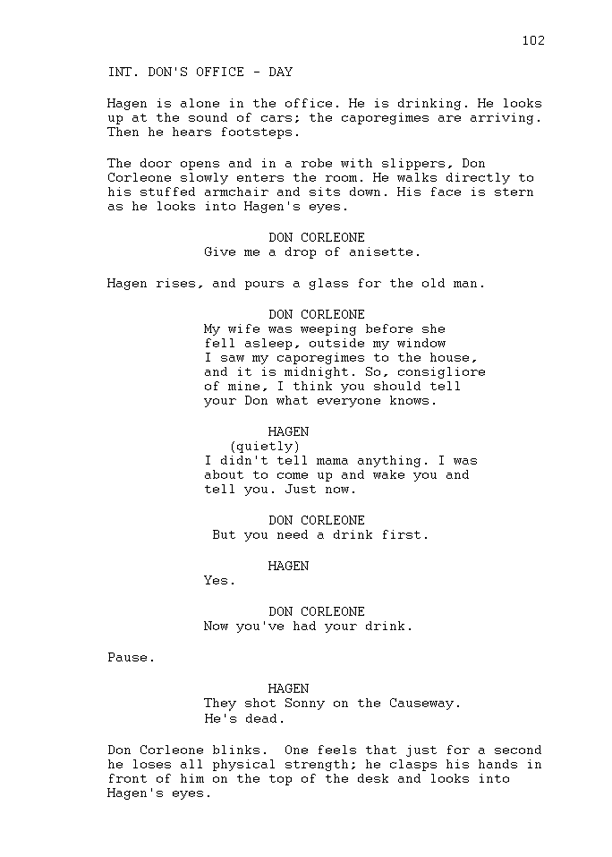
If you wish to have a character talking in the story, then they require dialogue. And for dialogue, an actor needs a script. A script is a written book of the story, with the actions and lines the characters would deliver. This gives the actor an idea on how to perform the character they are going for, and how they could deliver a voice for the character.
In this example below, we can see how a script should be laid out, making it easier to read for the actors. the text for dialogue should be aligned in the middle, separating the rest of the text which are the actions. the brackets in the dialogue illustrate the emotion or volume the character should deliver. In animation, only the dialogue is needed from the actors, but they still need to know how they should present it. acting it out can sometimes help them understand their character better, in order to feel more comfortable delivering dialogue.
source: http://filmschoolonline.com

Pre-Production - The Story Arc

The first thing that should be done in animation is the story. Whether its your own idea, or adapting from a book, you still need to write up the plot, the characters and the settings that are involved. In some cases, the plot can be at an ongoing process, like a book with many chapters. The story will take a lot of writing to make until it is satisfactory. sometimes, you'll have to re-write it a few times if some changes are needed.

There are eight points in the structuring a story. all of which flow into the plot and development on the character and background. If it is an everyday life scenario set in the story, that is called the "Stasis". In many major stories, there is the "trigger" and "quest" which involves the protagonist/hero and what they aiming for, like finding a map to an ancient treasure. Your story can have "surprise" which are several elements somewhere in the middle of the story, involving the character facing obstacles, conflict with another and any other type of trouble or danger. There should also involve the character having a "critical choice". This is like choosing the path between good or bad. If you aim for a unhappy ending, then it is most likely to consider the character making the wrong choice. All of this will result in the "climax" of the story. Almost drawing the end of the scene. The consequences of the choice can end with the "reversal" result on a character, changing their status and so on. And finally having the story resolved, having the character changed, but also ending the story. what reflects in the choice and climax, and even the reversal, the "resolution" can either be a good or bad ending for the character.

So in summary, an story arc requires:

  1. Stasis
  2. Trigger
  3. Quest
  4. Surprise
  5. Critical choice
  6. Climax
  7. Reversal
  8. Resolution

Friday, 17 May 2013

Summary


During my course, I have been learning about the types of animation there have been throughout the world, and how an animation is made through the production pipeline. Here I shall be explaining through the departments, and the animation pipeline itself. Animation can be made from any department:  2D, 3D or Stop-Motion. A 2D animation is made from drawing a series of frames by hand, which are then taken to be animated into a full-motion film. The most popular companies that have made Hand-drawn animation in the past are Disney and Warner Bros. Today, 2D can now be done by computers, using software like Flash. 3D animation is when the film gives a more realistic look. The depth and angles made by the cameras bring more life to the characters. 3D is more popular today after the success of Pixar and Dreamworks, as many other film companies are using 3D software to create an animated film. Stop-Motion is like an earlier form of 3D animation. With Stop-Motion, you can bring an inanimate object to life by a simple process of using a camera to take pictures of the object you’re using, moving it at a different angle or position at a time. The frames then taken from the camera can be pieced together into a full-motion animation. Aardman is an example, for they produce stop-motion animation
All of these departments however take a long amount of time to make an animated film. The Animation production is made into 3 processes. Pre-production is the start-up point of an animation, and it begins with making a storyboard. A storyboard is like making a comic strip, but while explaining the scenario and what actions the characters are doing. The storyboards are then taken to be examined, in order to make the character and background layouts. The characters will be made as model sheets, showing the size and design of the character, as well as creating sheets to show their expressions and movements. All of these drafted ideas are then taken to make an animatic of the film, showing the plot and the characters in the original design. The animatic is then taken into discussion as to what should be changed, i.e the character’s design may be changed if the original design’s body, face or what it is wearing is not approved. Then once the final concept is approved, it will be taken into the production line.
The production line is when you officially begin work on the actual film of your animation. In a 3-D animation, the character has to be modelled as followed from the design, providing it will be fully functional to the character’s movements. The character is also considered by how many features are needed to be made, for example the amount of fur or hair it has, and how would they react to the character’s motions. In 2-D, every drawing is made onto a Cel, which is then painted and taken to the camera to be shot. The process of the animation production line will vary depending on how long your film is aiming for. A Full-length feature may take over a few years to make.
The final process of an animation is the Post-Production line. Here, the film is taken to be edited by computers, which will add any effects to the film, and what needs to be cut from the film if any certain scenes are considered not to be in the final render. The sound will also be edited and given more depth to the dialogue and actions when played over the animation. The sound and video will be then synchronised and made into the final film. The film should then complete and ready for distribution, unless unapproved by the project manager.
In an animation, there are a few key elements to consider. When you look at a cartoon, you should look at what types of principles are used in an animation, which were introduced by Disney. Some examples include the squash-and-stretch effect, which helps build the body of the character, and its flexibility. Timing is also important, as it gives the cue for the character’s reaction and how long before the story leads to a pun.  The staging for the film will help give more audience attention, by showing the important part of the scene you are telling in the story. The character should also give more appeal to the audience by how it acts, to give it more life into the film.
So, from what I have learnt, there many alternative methods to making an animation. It is still used today to make animated films, but also to create short pieces for advertisements, television and other business needs. There are many ways you can make into the animation, which will make the audience more appealing when watching a fully-animated picture. However, in any department, making an animation is a slow-moving process, which will require a lot of time to produce, but can be easier to master on what department you want to work in.